Cluster pays awards wins for groups of five or more matching symbols touching on a grid, rather than on paylines. This review covers how the mechanic works, its effect on variance and return, the strongest titles for UK players, and its position under UK regulation.



Quick Verdict
Cluster pays awards a win when a minimum number of matching symbols — usually five or more — touch each other horizontally or vertically on a grid, replacing fixed paylines with an adjacency rule. The mechanic carries constraints worth knowing before playing. Unlike some grid mechanics, cluster pays is not inherently high-variance: it spans low-volatility titles such as Aloha! Cluster Pays through to extreme titles such as Hand of Anubis, so the label alone tells you little about the risk. On the higher-variance titles that dominate cluster pays slots UK players will meet, return concentrates in bonus rounds, dry spells are common, and the same title routinely runs at different return-to-player settings across operators — some as low as 88.41%. Dev-published defaults among the titles reviewed here sit between roughly 96.1% and 96.6%. The closest adjacent feature is scatter pays, which counts symbols anywhere without requiring them to touch.
Cluster Pays at a Glance
| Field | Value |
|---|---|
| Feature category | Mechanic (win-evaluation) |
| Originating studio + year | NetEnt (coined the term), Aloha! Cluster Pays, March 2016 (secondary-source; earlier cluster-style attempts existed) |
| Cross-provider availability | Wide (six-plus studios; “Cluster Pays” and “Megaclusters” are trademarked names, not the concept) |
| UK regulatory status | Legal at UKGC operators; bonus-buy and turbo variants restricted |
| Best-fit volatility tier | Spread from Low to Extreme; concentration at High |
| Typical RTP range | ≈96.1% to ≈96.6% dev-published; operator variants deploy far lower |
| Typical max-win ceiling | ≈700x to 50,000x across ranked titles |
| Verified for this review | 6 July 2026 |
Every figure in this review is tracked to its source. Studio-page figures are stated as such; anything sourced only from aggregators or player reports is framed as secondary or community-tracked.
How Cluster Pays Works
Cluster pays is a win-evaluation mechanic: it changes how a win is recognised, not how the reels are processed afterwards. A baseline slot pays when matching symbols land on a fixed line running left to right. A cluster pays slot abandons the line entirely and runs on a rectangular grid — 6×5, 7×7, 8×8, sometimes larger — where a payout forms whenever enough matching symbols connect to one another. Because the win depends on symbols touching rather than landing in a set pattern, cluster pays almost always pairs with a cascade so that cleared clusters can refill and connect again.
Core Mechanic
A cluster forms when a minimum number of identical symbols land adjacent to each other, horizontally or vertically, anywhere on the grid. The threshold is usually five or more, though the original Aloha! Cluster Pays required nine, and diagonal touching does not count. When a qualifying cluster lands, it pays according to the symbol and the cluster size — larger clusters pay more — and the winning symbols are then removed. Fresh symbols fall into the vacated positions, and the grid is re-evaluated: any new cluster pays and clears in turn. This continues until a refilled grid produces no cluster, at which point the round closes and the next paid spin becomes available. Several implementations layer persistence or multipliers over the loop. Aloha! holds winning clusters in place for a Sticky Win re-spin; Pragmatic Play’s Sugar Rush marks each winning position and doubles a local multiplier on repeat hits up to 128x, per the studio’s product page; Hacksaw Gaming’s Hand of Anubis attaches progressive multipliers to Soul Orb wilds. Cluster grids also run larger than payline reel sets — 7×7 and 8×8 layouts are common — so that clusters have room to form. The adjacency requirement is the defining trait — it makes the shape and position of a landing matter, not just the count.
Math Impact
Cluster pays changes the return model of a slot, but less predictably than mechanics that push variance in a single direction.
| Dimension | Impact direction | Notes |
|---|---|---|
| Variance | Higher, but wide-ranging | The adjacency rule alone does not set variance; the multiplier and bonus design does, giving titles from low to extreme |
| Hit frequency (base game) | Higher (nominal) | Large grids plus cascades create frequent small clusters — where published, hit rates run in the high-30% to low-40% range — though most base wins are small |
| Bonus trigger frequency | Same to Lower | Set by the maths model rather than the cluster rule; extreme titles trigger features infrequently |
| RTP distribution | Concentrated in bonus on high-variance titles | Multiplier-led titles hold most return for the feature; low-variance titles such as Aloha! distribute it more evenly |
The practical session consequence depends heavily on which title you pick. A low-variance cluster slot such as Aloha! Cluster Pays returns fairly steadily, with frequent small clusters and a modest 700x ceiling. A multiplier-led title such as Hand of Anubis, where free-spins multipliers reach x9,999, holds most of its return for the bonus and can lose at well above the headline rate during base play while you wait for a feature. Specific hit-frequency figures are published for some titles — Hand of Anubis is tracked at 36.92% per secondary sources — but trigger-frequency data is not consistently disclosed. The core discipline is to read each title’s volatility rating rather than assuming the mechanic behaves one way.
Cross-Provider Implementation Map
Studios implement cluster pays differently because the concept is not licensed. NetEnt trademarked the name “Cluster Pays” and Big Time Gaming trademarked its “Megaclusters” variant, but the underlying adjacency mechanic is used freely across the industry — which is why studios build their own grids, thresholds, and feature layers on top.
| Studio | Studio-specific name | Notable titles | Key variation |
|---|---|---|---|
| NetEnt | Cluster Pays (trademarked) | Aloha! Cluster Pays, The Legend of Shangri-La, 101 Candies, Berryburst | Coined the term; 6×5 grids, Sticky Win re-spins, Symbol Drop free spins; often lower variance |
| Play’n GO | Grid / cascading clusters | Reactoonz, Reactoonz 2, Gigantoonz, Gemix | 7×7 grids with charge meters (Quantum features) that convert cluster wins into wild effects |
| Pragmatic Play | Cluster pays | Sugar Rush, Gems Bonanza, Candy Rush | Tumble plus persistent multiplier spots or random base-game modifiers; high variance |
| Push Gaming | Cluster / Cluster Link | Jammin’ Jars, Jammin’ Jars 2, Giga Jar, Retro Tapes | Collapse loop with jumping Wild multipliers that relocate and increment across clusters |
| Hacksaw Gaming | Cluster pays | Hand of Anubis, Le Bandit, Sun Princess | Multiplier-led wilds and hold-and-win bonuses; multi-tier RTP deployed aggressively |
| Big Time Gaming | Megaclusters (trademarked) | Star Clusters Megaclusters, Cyberslot Megaclusters, Millionaire Rush | Winning symbols split into four smaller symbols on a shape-shifting grid, expanding the ways to reconnect |
The most mechanically distinctive implementation is Big Time Gaming’s Megaclusters, where each cleared symbol splits into four smaller ones rather than simply refilling, so the grid grows denser through a chain rather than staying fixed. Play’n GO’s charge-meter model is the next most distinctive, converting accumulated cluster wins into grid-clearing wild features. The variations matter most in the bonus round and at the extremes of variance: NetEnt’s early titles keep variance low with sticky re-spins, while Hacksaw layers x9,999 multipliers on top of the same adjacency rule. Because only the branded names are trademarked, any studio can build a cluster grid, which is why cluster pays appears across independent engines with no shared licence.
Best Cluster Pays Slots Ranked
A slot ranks well for this feature when the cluster grid is central to the maths rather than cosmetic, when its return-to-player is transparent and reasonably high, and when its implementation adds something distinctive to the adjacency loop. Ranking follows SlotRover editorial order weighted across top RTP, lowest known RTP risk, volatility suitability, mechanic originality, UK availability, max-win ceiling, and feature-quality of implementation — not a guarantee of player outcomes.
| Rank | Title | Studio | RTP top | Volatility | Max Win | Feature-specific behaviour |
|---|---|---|---|---|---|---|
| 1 | Sugar Rush | Pragmatic Play | 96.50% | High | 5,000x | 7×7 cluster tumble; multiplier spots persist and double up to 128x |
| 2 | Reactoonz | Play’n GO | 96.51% (secondary) | High | 4,570x (secondary) | 7×7 cascading clusters; Quantum charge meter converts wins into wild features |
| 3 | Jammin’ Jars 2 | Push Gaming | 96.40% (varies) | High | 50,000x | 8×8 cluster collapse; jumping Wild Jar multipliers that relocate and increment |
| 4 | Gems Bonanza | Pragmatic Play | ≈96.55% (secondary) | High | 10,000x | 8×8 cluster; five base-game modifiers plus the Gold Fever progressive meter |
| 5 | Hand of Anubis | Hacksaw Gaming | 96.24% (secondary) | Very High | 10,000x | 5×6 cluster; Soul Orb wild multipliers; Underworld and Judgement bonuses |
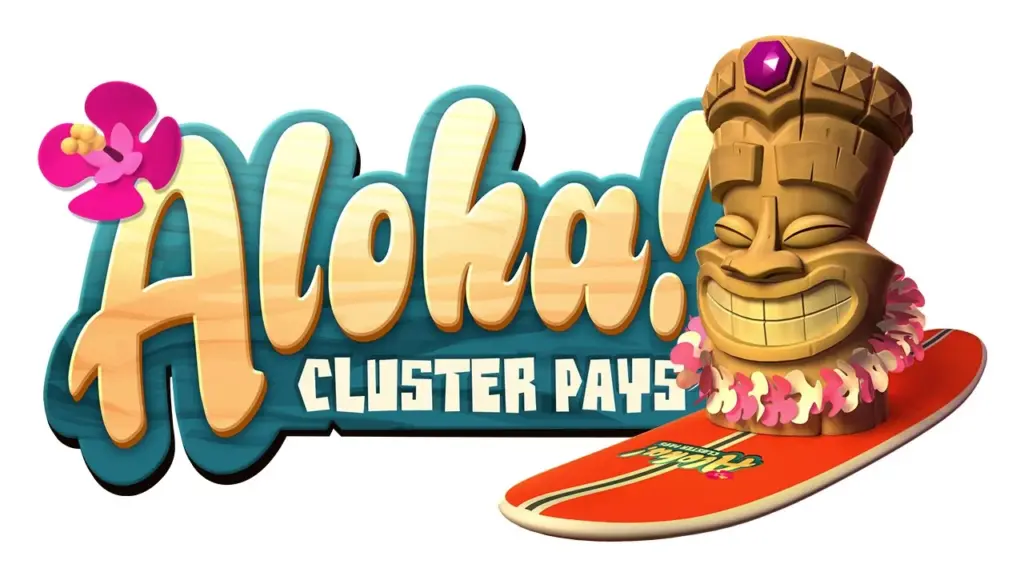
| 6 | Aloha! Cluster Pays | NetEnt | 96.42% | Low | 700x | 6×5 grid, 9+ clusters; Sticky Win re-spins; Symbol Drop free spins |
Sugar Rush
Sugar Rush ranks highest because its cluster grid drives the maths and its return is confirmed at source. Pragmatic Play’s product page lists 96.50% and describes the 7×7 cluster tumble where five or more matching symbols pay and clear. Its distinctive layer is the multiplier spot: a marked winning position doubles its multiplier on repeat hits up to 128x, persisting through the bonus. The Global Gaming Awards named it Online Slot of the Year in 2023. The limitation is the modest 5,000x ceiling — low against Jammin’ Jars 2 — so the appeal is multiplier interaction, not a headline prize.
Reactoonz
Widely regarded as the definitive grid slot, Reactoonz is where many UK players first met cluster pays. Play’n GO’s own page confirms the 7×7 cascading grid and the five-or-more cluster rule, with the Quantum charge meter converting winning clusters into Gargantoon wild features. Secondary sources put the return at 96.51% and the ceiling at 4,570x; Play’n GO does not publish the figure on its marketing page, so both are secondary. The caution is variance and variant deployment: this is a high-volatility title with operator-adjustable return, so the in-game panel is the only reliable reference.
Jammin’ Jars 2
Push Gaming’s sequel carries the highest ceiling in this list — a max win the studio’s own release confirms rose from 20,000x on the original to 50,000x here. The collapse loop runs on an 8×8 cluster grid, and its distinctive element is the Wild Jar multiplier that jumps to a new position and climbs by one each time it feeds a cluster. It won Game of the Year at the 2021 EGR Operator Awards. Push states plainly that return-to-player varies per casino, so the roughly 96.40% figure quoted by aggregators is secondary. High volatility is the trade-off for the ceiling.
Gems Bonanza
An 8×8 grid with five base-game modifiers, Gems Bonanza is Pragmatic Play’s higher-ceiling cluster entry, paying for clusters of five or more and topping out at 10,000x. Its distinctive layer is the Gold Fever progressive meter, filled by collecting symbols across consecutive tumbles to unlock multipliers up to 10x, alongside random modifiers such as Nuclear and Colossal. Secondary sources cite a ≈96.55% default with reduced operator versions at 95.54% and 94.53%, so the figure is not dev-confirmed here. High variance is rated 5/5, though the frequent modifiers soften the base-game grind.
Hand of Anubis
Hand of Anubis is the darkest and most volatile entry here, a 5×6 cluster slot where Soul Orb wilds carry progressive multipliers and free-spins multipliers reach x9,999. Secondary sources place the top return at 96.24% and the ceiling at 10,000x, with a 5/5 volatility rating. The limitation is transparency: Hacksaw deploys the title across multiple tiers recorded as low as 94.32%, 92.28%, and 88.41%, so the return a UK player receives can sit well under the headline. The turbo animation control it offers internationally is restricted in UK builds, and the feature buy is disabled.
Aloha! Cluster Pays
The origin title and the source of the “Cluster Pays” trademark, Aloha! is the only genuinely low-variance option in this list. NetEnt’s own page confirms 96.42% and a 700x ceiling, with the 6×5 grid requiring nine or more touching symbols, Sticky Win re-spins holding winning clusters, and a Symbol Drop free-spins round. Notably, aggregator listings cite 98.01% and 1,000x, neither of which matches NetEnt’s page — a clear reason to trust the studio figure. The limitation is that 700x ceiling, modest by modern standards, which is the trade-off for the steady low-variance return.
Cluster Pays by Volatility Tier
Cluster pays spreads across the variance spectrum more than most grid mechanics, because the adjacency rule itself is variance-neutral and the multiplier design does the work. That produces genuine low-volatility titles at one end and extreme titles at the other. The distribution below uses each title’s commonly published volatility rating; where studios present volatility as a bar rather than a word, secondary ratings are used and framed as such.
| Volatility tier | Representative titles | Practical notes |
|---|---|---|
| Low | Aloha! Cluster Pays, 101 Candies (low–medium) | Steadier returns and frequent small clusters; suitable for longer sessions within a set limit |
| Medium | Berryburst, some NetEnt Cluster Pays titles | Moderate swings; keep stakes proportionate to a preset limit |
| High | Sugar Rush, Reactoonz, Gems Bonanza, Jammin’ Jars 2 | Long stretches of small returns between features; stakes kept low against a firm limit |
| Extreme | Hand of Anubis | Boom-or-bust; large balance swings are normal and the ceiling is reached only rarely |
For UK players choosing this feature, the spread means the label “cluster pays” is not a shortcut to a risk profile. A player who wants steadier play has a genuine option in the low tier, which cascading reels does not offer. A player chasing the 50,000x ceilings is choosing a high-variance title where non-triggering runs are common. The single most useful habit is to open the game information panel and read the volatility rating and deployed return before the first spin, because two cluster titles can behave nothing alike.
Cluster Pays Cost of Play at GB Stake Caps
The headline return on a cluster pays slot translates into a theoretical hourly loss, which is a statistical average across many hours rather than a session prediction. Variance on the higher-volatility titles is high enough that real sessions land well above or below these figures — base-game-only runs can lose faster than the headline rate, and a bonus-heavy session can win at a multiple of the long-run expectation. The figures below are grounded in cluster pays slots RTP data verified at studio pages.
The figures below show portfolio extremes — the highest dev-published return across feature-using titles and the lowest dev-published return, drawn from different titles. They illustrate the spread players may encounter across feature-using slots, not a single playable configuration pair. Both are default studio-published figures; operators may deploy reduced-return versions that push the loss higher still.
| Stake per spin | Theoretical hourly loss at top dev-published RTP (96.58%, Sugar Rush Super Scatter) | Theoretical hourly loss at lowest dev-published RTP (96.08%, 101 Candies) |
|---|---|---|
| £0.10 | £2.05 | £2.35 |
| £1.00 | £20.52 | £23.52 |
| £5.00 (GB cap for 25+) | £102.60 | £117.60 |
| £2.00 (GB cap for 18–24) | £41.04 | £47.04 |
At £5 a spin — the GB cap for players aged 25 and over — 600 spins an hour at 96.58% implies 600 × £5 × 0.0342 = £102.60 in theoretical hourly loss; at 96.08% the same 600 spins imply £117.60. The 96.58% figure traces to Sugar Rush Super Scatter (Pragmatic Play); the 96.08% figure traces to 101 Candies (NetEnt). A player will not meet both rates in a single session unless they switch titles, and operators deploy reduced versions far lower — Hand of Anubis has been recorded down to 88.41% per secondary-source tracking, at which £5 a spin implies roughly £347.70 an hour in theoretical loss, over three times the top-RTP figure.
These numbers are long-run averages. On the multiplier-led cluster titles that hold return for the bonus, a base-game-only session waiting for a trigger can lose faster than these rates, while a session that catches an extended cascade chain inside free spins can return a multiple of the stake. Neither outcome contradicts the average; both are the average expressing itself over a short window.
UK Regulatory Status
Cluster pays as a mechanic is fully legal at operators licensed by the UK Gambling Commission. The cluster grid, the cascades, the multiplier layers, and the free-spins rounds all run in UK builds exactly as they do elsewhere. What UK regulation restricts is not the adjacency mechanic but several features that commonly ship alongside it on cluster pays slots online, which is where the meaningful player-facing differences appear.
The most significant restriction concerns bonus buy. Many popular cluster titles — Sugar Rush, Gems Bonanza, Hand of Anubis — offer a button to purchase the bonus in international markets, and that button is removed on the version served to UK players. The basis is the Commission’s action against feature buy-in facilities. The Commission’s warning to online operators was published on 17 January 2020, and per the Commission’s own update the page was last updated on 17 May 2021, by which point all six operators it had contacted had removed the facility; one game had been charging more than £3,000 to enter the bonus. The legal basis is RTS 14A, which requires that gambling products must not actively encourage customers to chase losses, increase their stake, or continue after they have indicated they wish to stop. This is not a “February 2023 ban” or an “October 2021 ban”, and it is not RTS 14C — those framings appear in rival copy but do not match the documented enforcement.
Several other standards shape UK cluster builds. Under RTS 14D, a slot game cycle must run a minimum of 2.5 seconds, and because a full cluster cascade sequence is a single game cycle, rapid animations cannot be used to drop a round below that floor. RTS 14E prevents a slot from letting a customer reduce the time to the result, which removes turbo, quick-spin, and slam-stop — so the turbo animation control that titles such as Hand of Anubis carry elsewhere is absent from UK versions. Autoplay is separately prohibited under RTS 8, and RTS 14F bars a game from celebrating a return that is less than or equal to the stake, which matters because a short cluster chain can net below the spin’s cost. Finally, RTS 6 requires that a play-for-free game on an operator’s own site mirror the real-money configuration; studio and third-party demo pages frequently run the highest return setting, so a demo return is not proof of the version an operator deploys.
Cluster Pays vs Scatter Pays
Scatter pays is the most useful comparator because it is the other main way modern slots replace paylines, and UK players routinely choose between the two — Sugar Rush is cluster pays, Sweet Bonanza is scatter pays, and both are Pragmatic Play tumble slots.
| Metric | Cluster Pays | Scatter Pays (Pays Anywhere) |
|---|---|---|
| Mechanic family | Adjacency win evaluation — symbols must touch | Count win evaluation — symbols anywhere, no adjacency needed |
| Typical max-win range | ≈700x–50,000x across titles | ≈5,000x–50,000x (Gates of Olympus 5,000x; Sweet Bonanza 21,175x) |
| Typical volatility | Low to Extreme, concentrating at High | Medium-high to Very High |
| UK regulatory status | Legal at UKGC operators; bonus-buy and turbo variants disabled | Legal at UKGC operators; bonus-buy disabled, Ante Bet permitted |
| Signature studios | NetEnt, Play’n GO, Pragmatic Play, Push Gaming, Hacksaw Gaming | Pragmatic Play (dominant), plus scattered use elsewhere |
| Best-fit player | Wants positional, adjacency-based wins on a large grid | Wants simple count-based wins without positioning |
The features diverge on one rule: cluster pays requires matching symbols to touch, while scatter pays only requires enough of them to land anywhere. That makes cluster wins positional — where symbols fall matters — and scatter-pays wins purely quantitative. Cluster titles tend to use a lower threshold (five) on a bigger grid; scatter-pays titles use a higher threshold (eight) on a 6×5 grid. Both lean on tumbles, so the visible action can look similar. Return-to-player is set independently of either. For a fixed session budget, neither is structurally safer — the deciding factors are the deployed return and the published volatility rating. Cluster pays does, however, offer genuine low-variance options that scatter pays largely does not.
Who Plays Cluster Pays Slots
Grid-mechanic enthusiasts are the natural fit. Players who prefer the puzzle-like feel of symbols connecting on a large grid, over lining up a fixed pattern, get the most from cluster pays — and the adjacency rule gives the mechanic a spatial quality that payline slots lack. Reactoonz and its 7×7 grid built much of this audience.
Variance-flexible players are a second group, and this is where cluster pays stands apart. Because the mechanic spans low to extreme, a player can pick Aloha! Cluster Pays at 96.42% for steadier low-variance play or Hand of Anubis for x9,999 multiplier potential, without leaving the feature. That range is unusual and lets one mechanic suit very different risk appetites.
Ceiling-chasers form a third. The highest-ceiling cluster titles carry the headline top prizes — Jammin’ Jars 2 at 50,000x — for players who accept long non-triggering runs in exchange for rare, large bonus outcomes, and who treat the ceiling as a cap rather than a target.
The feature does not suit players who want the buy-bonus shortcut, which is disabled on every UK version, or who expect turbo speed, which UK builds do not permit. Players who dislike large grids and prefer a small, readable reel set may also find the busy 7×7 and 8×8 layouts harder to follow.
Common Mistakes
Assuming cluster pays means high variance. The mechanic spans low-volatility titles such as Aloha! Cluster Pays through to extreme titles such as Hand of Anubis. The adjacency rule does not set the risk; the multiplier and bonus design does. Judging a cluster slot’s variance from the mechanic alone, rather than its published rating, leads players to underfund an extreme title or overlook a genuinely steady one.
Ignoring return-to-player variant deployment. Cluster titles are deployed across some of the widest return ranges in the market. Hand of Anubis has been recorded at 96.24%, 94.32%, 92.28%, and 88.41% depending on the operator. Checking the in-game information panel on the specific site, rather than trusting a review figure, is the only way to know the version you are actually playing.
Trusting a demo’s return figure. Studio and third-party demo pages frequently run the highest available return setting, so a demo showing a high figure does not confirm what an operator deploys for real money. Under RTS 6, a demo on the operator’s own site must mirror its real-money configuration, but a supplier demo need not — verify in the live game.
Reading each cascade as a separate win. A cluster chain can produce several small clears that net below the stake for that spin. UK builds cannot celebrate a return that is less than or equal to the stake under RTS 14F, but the animation can still make a losing spin feel like a win. The spin’s net result against its cost is the figure that matters.
Believing a big cluster is overdue. After a run of small clusters or dead spins, no large cluster or feature becomes more likely. A certified random number generator does not track how long you have waited, and each spin is independent — a dry stretch is the high-variance maths behaving as designed.
How This Review Was Verified
Return-to-player figures for Sugar Rush (96.50%), Sugar Rush Super Scatter (96.58%), and the scatter-pays comparator titles Sweet Bonanza (96.48%) and Gates of Olympus (96.50%) were read directly on Pragmatic Play’s own product pages, and Aloha! Cluster Pays (96.42%, 700x) and 101 Candies (96.08%) on NetEnt’s own pages. Jammin’ Jars 2’s 50,000x max win was confirmed against Push Gaming’s own release, though Push states its return varies per operator, so that figure is secondary. The UKGC regulatory position — the bonus-buy enforcement dates and the RTS 6, 14A, 14D, 14E, 14F, and 8 wording — was verified against the Commission’s own pages. Reactoonz, Gems Bonanza, and Hand of Anubis return figures and most volatility ratings are secondary; Play’n GO, Push, and Hacksaw do not publish a single default RTP on their marketing pages. Operator-specific variants were not independently confirmed and should be checked in-game. Verification date: 6 July 2026.
Responsible Gambling
The variance reality on this feature depends on the title, which is worth stating plainly. On the higher-variance cluster titles that dominate the category, extended dry spells, large balance swings, and bonus rounds that pay below the headline expectation are mathematical characteristics of the model rather than signs that anything is wrong. Even the low-variance titles carry a house edge, and no cluster slot returns a profit over the long run.
If gambling stops feeling like entertainment, support is free and immediate. GamStop provides free self-exclusion across every UKGC-licensed site in minutes. The National Gambling Helpline, run through BeGambleAware, is available on 0808 8020 133, free and confidential, 24 hours a day. GamCare offers a free helpline and counselling. Every UKGC-licensed casino also provides deposit limits, session time limits, and cool-off periods that take effect without a waiting period, and setting these before a session begins is the most effective single safeguard.
Every UKGC-licensed casino is strictly 18 and over. Stake caps apply at £5 per spin for players aged 25 and over and £2 per spin for players aged 18 to 24. If a session causes distress, the right response is to stop and use the support services above rather than continue.